

Architecture
Domino Nexus control planes host several important services which must be accessible from data plane clusters: Domino API - This is the API which is used by the Domino CLI, UI, and now data planes. Ingress is already configured on the main endpoint by which users access Domino. This endpoint should be routable from data plane clusters. Because this is already configured, this guide does not discuss it further. Vault - Data plane clusters use HashiCorp’s Vault to authenticate with the control plane, encrypt secrets in transit, and authenticate with RabbitMQ. Communication with Vault happens over HTTPS on port 8200. RabbitMQ - The primary communication channel between the Domino control plane and the data plane is based on RPC over RabbitMQ. Additionally, data planes publish execution state back to the control plane over RabbitMQ. This communication occurs using AMQP and RabbitMQ Stream protocols on ports 5672 and 5552. Docker Registry - If you are using Domino’s internal Docker Registry then data plane Kubelets must be able to access the registry over HTTPS on port 443. This is used to pull environment images for user executions. Vault and RabbitMQ in particular are sensitive services. Authentication and authorization for these services is tightly controlled. These services should not be generally available to the public Internet, to reduce the risk of compromised credentials or vulnerabilities in the services themselves.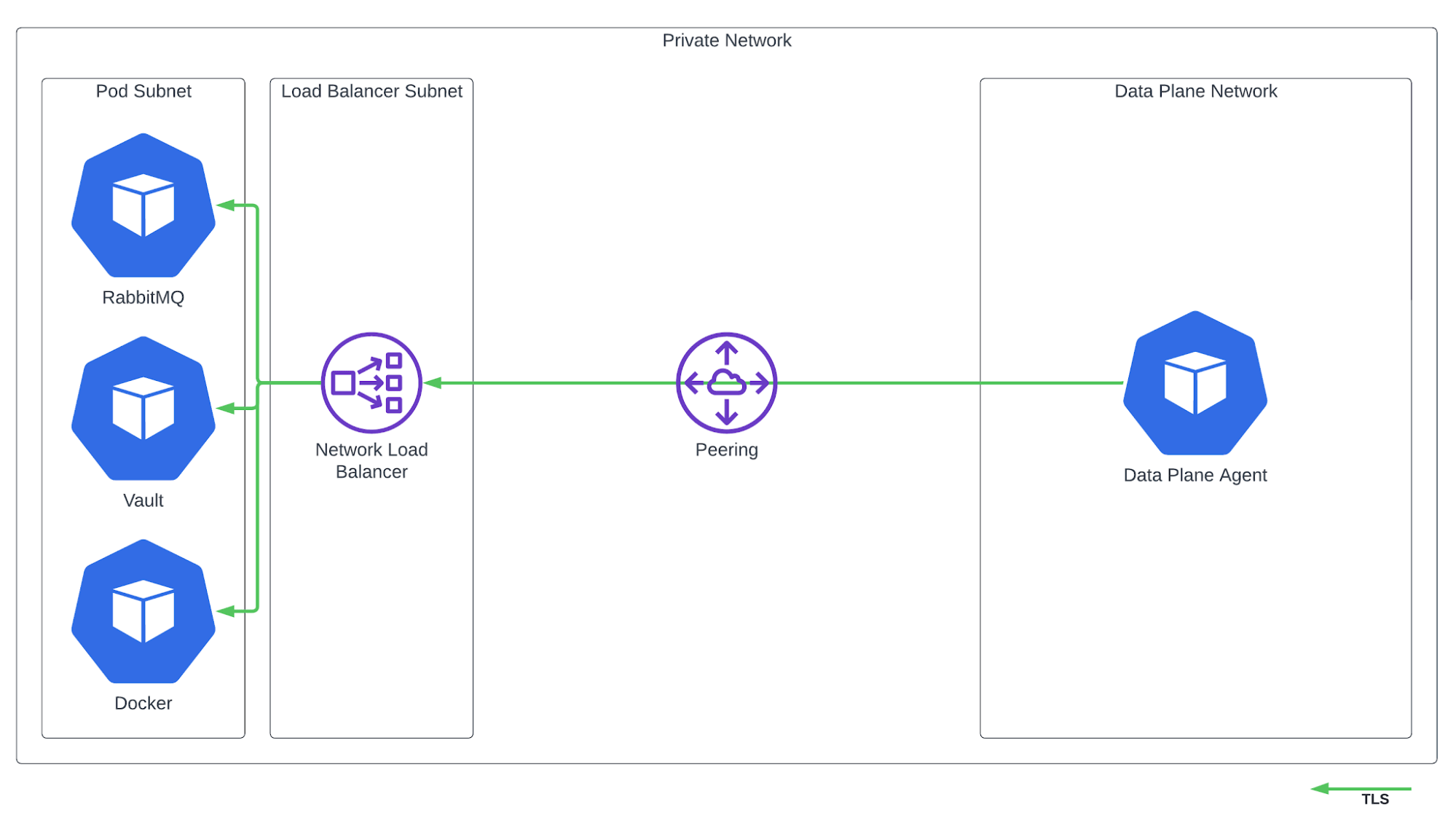
Load balancers
Load balancers are typically used for Kubernetes ingress to route traffic from a stable DNS host to the variable set of cluster nodes hosting the service. Most infrastructure providers are able to configure Layer 4 (Network) and / or Layer 7 (Application) load balancers. Application load balancers can be used for Vault and Docker Registry because they use HTTPS, however a network load balancer is required for RabbitMQ because it is using AMQP.TLS termination
Data planes must communicate with the control plane services using TLS. These services do not support serving TLS connections themselves (unless Istio is in use, see below), and so load balancers must perform TLS termination. If your company issues non-public certificates, these can be used here, however see Domino’s administrator documentation for guidance on creating data planes when non-public certificates are in use.Network access
Load balancers should not be accessible from the public Internet. This can be achieved in two ways:- The recommended way is to configure internal load balancers, which sit in a private subnet, do not have a public IP address, and are only accessible using private networking such as VPN or peering. Even with internal load balancers, you should limit source IP ranges to subnets which you expect to host data plane services.
- If your company does not have private networking between Nexus clusters, you must restrict the network CIDRs which can access your load balancers. This involves identifying the IP addresses for NAT gateways used by data plane services, and limiting load balancer access to these source ranges, either through load balancer configuration or network security groups.