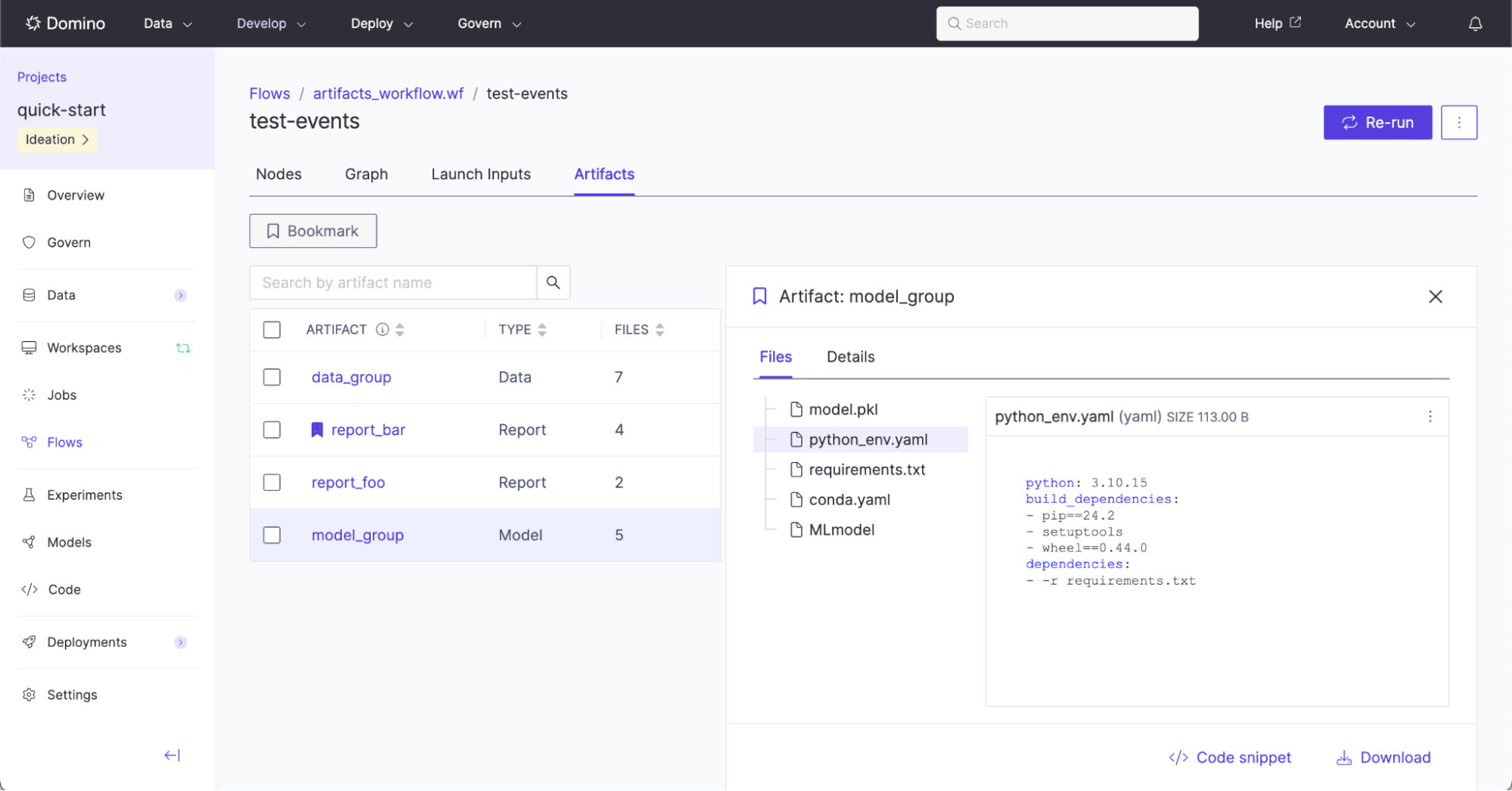
A complex flow may execute many steps, producing hundreds of outputs, the majority of which are typically intermediate computations and not final results. It therefore becomes useful to elevate outputs of flow executions to easily discover, reuse, and inspect them, including the lineage of how they were produced. These task or workflow outputs are called Flow Artifacts.Flow Artifacts are explicitly defined in code by flow definition authors.The Artifact method is used to generate a named artifact. The named artifact can have individual files added to it anywhere in the workflow definition. Typically an Artifact is declared at the beginning of a workflow like this:
In any part of a workflow where an output might be used, the .File(name="file.ext") method can be called to declare that the output is an Artifact. For example:
DATA artifact: Files that may be added later as a new dataset snapshot.
MODEL artifact: Files that may later be registered as a model.
REPORT artifact: Files that may be part of a collection that make up a report.
In the following example, DataArtifact.File(name="data.csv") adds a FlyteFile output from the data_prep_job to the Flow Artifact declared as Artifact(name="My Data", type=DATA). Unlike the use of FlyteFile[TypeVar("csv")] from previous examples, Flow Artifact files automatically infer their type from the given file extension.
from flytekit import workflowfrom flytekit.types.file import FlyteFilefrom flytekitplugins.domino.task import DominoJobConfig, DominoJobTaskfrom flytekitplugins.domino.artifact import Artifact, DATA, MODEL, REPORT# define the artifact name and type which may be REPORT, DATA or MODELDataArtifact = Artifact(name="My Data", type=DATA)ModelArtifact = Artifact(name="My Model", type=MODEL)@workflowdef training_workflow(data_path: str) -> ModelArtifact.File(name="model.pt"): data_prep_job_config = DominoJobConfig(Command="python prep-data.py") data_prep_job = DominoJobTask( name='Prep data', domino_job_config=data_prep_job_config, inputs={'data_path': str}, outputs={'processed_data': DataArtifact.File(name="data.csv")}, use_latest=True ) data_prep_results = data_prep_job(data_path=data_path) training_job_config = DominoJobConfig(Command="python train-model.py") training_job = DominoJobTask( name='Train model', domino_job_config=training_job_config, inputs={'processed_data': FlyteFile[TypeVar("csv")]}, outputs={'model': FlyteFile[TypeVar("pt")]}, use_latest=True ) training_results = training_job(processed_data=data_prep_results["processed_data"]) return training_results["model"] # Final output is returned here
There are no limits to the number of Flow Artifacts that can be defined, the number of files that can be added to each Flow Artifact, or where the Flow Artifact files are created. However, an individual Flow Artifact cannot include the same filename more than once. The following is not permitted because DataArtifact.File(name="data.csv") is used more than once:
DataArtifact = Artifact(name="My Data", type=DATA)@workflowdef training_workflow(data_path: str) -> DataArtifact.File(name="data.csv"): data_prep_job_config = DominoJobConfig(Command="python prep-data.py") data_prep_job = DominoJobTask( outputs={ # error - DataArtifact already has another data.csv 'raw_data': DataArtifact.File(name="data.csv"), 'processed_data': FlyteFile[TypeVar("csv")], } ) data_prep_results = data_prep_job(data_path=data_path) return data_prep_results["processed_data"] # Final output is returned here
Programmatically Exporting to Domino Datasets and NetApp Volumes
Flow Artifacts can be programmatically exported to Domino Datasets and NetApp Volumes. This is useful for enabling continuous, automated movement of new output data into Datasets and NetApp Volumes.
When you include run_launch_export_artifacts_task inside a workflow, Domino will generate a separate export execution that runs independently of the main workflow run. In the Graph view, the export launch node may appear near the start of the graph (for example, at n0) and can execute before downstream tasks have completed – this is expected behavior. The launch task only triggers the export process, and the actual export execution waits for the main workflow to finish and for all referenced Flow Artifacts to be fully generated.This design means that the visual placement of the launch node in the Graph view does not reflect the true ordering of when Flow Artifacts are exported. To verify export progress, open the separate export execution linked in the launch task’s logs. That execution contains detailed logs for each exported Flow Artifact.
In the following example, DataArtifact.File(name="data.csv") is programmatically exported to the Domino Dataset with ID 681d3030ae3a706ef9c7f08b, and the NetApp Volume with ID 5d1204c2-24c8-47df-a47f-69185efa602b using the helper method run_launch_export_artifacts_task.
from flytekit import workflowfrom flytekit.types.file import FlyteFilefrom flytekitplugins.domino.task import DominoJobConfig, DominoJobTaskfrom flytekitplugins.domino.artifact import Artifact, DATA, ExportArtifactToDatasetsSpec, ExportArtifactToNetAppVolumesSpec, MODEL, REPORT, run_launch_export_artifacts_task# define the artifact name and type which may be REPORT, DATA or MODELDataArtifact = Artifact(name="My Data", type=DATA)ModelArtifact = Artifact(name="My Model", type=MODEL)@workflowdef training_workflow(data_path: str) -> ModelArtifact.File(name="model.pt"): data_prep_job_config = DominoJobConfig(Command="python prep-data.py") data_prep_job = DominoJobTask( name='Prep data', domino_job_config=data_prep_job_config, inputs={'data_path': str}, outputs={'processed_data': DataArtifact.File(name="data.csv")}, use_latest=True ) data_prep_results = data_prep_job(data_path=data_path) training_job_config = DominoJobConfig(Command="python train-model.py") training_job = DominoJobTask( name='Train model', domino_job_config=training_job_config, inputs={'processed_data': FlyteFile[TypeVar("csv")]}, outputs={'model': FlyteFile[TypeVar("pt")]}, use_latest=True ) training_results = training_job(processed_data=data_prep_results["processed_data"]) # Programmatic export is enabled here run_launch_export_artifacts_task( spec_list=[ ExportArtifactToDatasetsSpec( artifact=DataArtifact, dataset_id="681d3030ae3a706ef9c7f08b", ), ExportArtifactToNetAppVolumesSpec( artifact=DataArtifact, netapp_volume_id="5d1204c2-24c8-47df-a47f-69185efa602b", target_relative_path="flows-data", ) # ... More exports can be defined in this list, if needed. ], environment_name="Domino Standard Environment", hardware_tier_id="small-k8s", use_project_defaults_for_omitted=True, ) return training_results["model"] # Final output is returned here
The helper method run_launch_export_artifacts_task performs the programmatic export.It is required to specify this task to use the Domino Standard Environment (DSE) from 6.0 onwards, or a custom environment that is built on top of the DSE >= 6.0, as these contain the required Flyte Python and jq dependencies.The full list of available parameters to the method run_launch_export_artifacts_task include:
If set to True, this will use the latest project defaults for parameters that were not explicitly provided. For better reproducibility, it is recommended to set this to False and explicitly define the necessary parameters. Example: False
environment_name
Optional[str]
Name of the Environment to use in the Domino Job. Example: Domino Standard Environment
environment_id
Optional[str]
ID of the Environment to use in the Domino Job. This is recommended over using environment_name to prevent breaking reproducibility when environment names get changed. Example: 6646530dcbd
environment_revision_id
Optional[str]
A specific revisionId of the environment to use. Example: 6659daf5fc8
hardware_tier_name
Optional[str]
Name of the hardware tier to use in the Domino Job. It is recommended to use a minimal-resource hardware tier. Example: Large
hardware_tier_id
Optional[str]
ID of the hardware tier to use in the Domino Job. This is recommended over using hardware_tier_name to prevent breaking reproducibility when hardware tier names get changed. It is recommended to use a minimal-resource hardware tier. Example: small-k8s
retries
int
Number of times to retry this task during a workflow execution. Example: 0
timeout
Union[timedelta, int] = timedelta(hours=3)
The maximum amount of time for which one execution of this task should be executed. The execution will be terminated if the runtime exceeds the given timeout. It is recommended to set this timeout duration to be greater than the workflow duration. Example: timedelta(hours=3)
Data artifact with a single file:Example scenario: A flow produces a single ADaM dataset with the file name adae.sas7bdat and the user wants to track the single file under its own data entity called adae.
Data artifact with multiple files:Example scenario: A flow produces multiple ADaM datasets (adae.sas7bdat, advs.sas7bdat, and adsl.sas7bdat) and the user wants to track the collection of files under a single data entity called adam.
Expand for example code.
from typing import Tuple, TypeVarfrom flytekitplugins.domino.helpers import Output, run_domino_job_taskfrom flytekitplugins.domino.artifact import Artifact, DATAfrom flytekit import workflowfrom flytekit.types.file import FlyteFileDataArtifact = Artifact("adam", DATA)@workflowdef multiple_adam() -> Tuple[ DataArtifact.File(name="adae.sas7bdat"), DataArtifact.File(name="advs.sas7bdat"), # if name does not include the extension, then provide the type kwarg DataArtifact.File(name="adsl dataset", type="sas7bdat"),]: # files in an Artifact can be produced by different Flows tasks # in this example, one task produces two of the files, and another task produces the third adae_dataset, advs_dataset = run_domino_job_task( flyte_task_name="Produce adae and advs Datasets", command="produce_adae_and_advs.py", output_specs=[ Output(name="adae", type=FlyteFile[TypeVar("sas7bdat")]), Output(name="advs", type=FlyteFile[TypeVar("sas7bdat")]), ], use_project_defaults_for_omitted=True, ) adsl_dataset = run_domino_job_task( flyte_task_name="Produce adsl Dataset", command="produce_adsl.py", output_specs=[ Output(name="adsl", type=FlyteFile[TypeVar("sas7bdat")]), ], use_project_defaults_for_omitted=True, ) return adae_dataset, advs_dataset, adsl_dataset
Model artifact with a single file:Example scenario: A flow produces a single model file with the name model.pkl and the user wants to track the single file as its own model entity.
Expand for example code.
from typing import TypeVarfrom flytekitplugins.domino.helpers import Output, run_domino_job_taskfrom flytekitplugins.domino.artifact import Artifact, MODELfrom flytekit import workflowfrom flytekit.types.file import FlyteFileModelArtifact = Artifact("My Model", MODEL)@workflowdef single_model() -> ModelArtifact.File(name="model.pkl"): return run_domino_job_task( flyte_task_name="Produce model", command="produce_model.py", output_specs=[ # name of the Output can differ from the name of the ArtifactFile Output(name="my_model", type=FlyteFile[TypeVar("pkl")]), ], use_project_defaults_for_omitted=True, )
Model artifact with multiple files:Example scenario: A flow produces multiple files relating to a model (model.pkl, classes.txt) and the user wants to track the collection of files as a single model entity.
Expand for example code.
from typing import Tuple, TypeVarfrom flytekitplugins.domino.helpers import Output, run_domino_job_taskfrom flytekitplugins.domino.artifact import Artifact, MODELfrom flytekit import workflowfrom flytekit.types.file import FlyteFileModelArtifact = Artifact("My Model", MODEL)@workflowdef multiple_model() -> Tuple[ ModelArtifact.File(name="model.pkl"), # if name does not include the extension, then provide the type kwarg ModelArtifact.File(name="classes", type="txt"),]: return run_domino_job_task( flyte_task_name="Produce model with classes", command="produce_model_with_classes.py", output_specs=[ # name of the Output can differ from the name of the ArtifactFile Output(name="my_model", type=FlyteFile[TypeVar("pkl")]), Output(name="my_classes", type=FlyteFile[TypeVar("txt")]), ], use_project_defaults_for_omitted=True, )
Report artifact with a single file:Example scenario: A flow produces a single TFL report with the file name t_vscat.pdf and the user wants to track the single file as its own report entity.
Report artifact with multiple files:Example scenario: A flow produces multiple TFL reports (t_vscat.pdf, t_ae_rel.pdf) at different steps in the workflow and the user wants to track the collection of files as a single report entity.
Expand for example code.
from typing import Tuple, TypeVarfrom flytekitplugins.domino.helpers import Output, run_domino_job_taskfrom flytekitplugins.domino.artifact import Artifact, REPORTfrom flytekit import workflowfrom flytekit.types.file import FlyteFileReportArtifact = Artifact("TFL Reports", REPORT)@workflowdef multiple_report(): # files in an Artifact can be produced by different Flows tasks # in this example, one task produces one file, and another task produces the other vscat_pdf = run_domino_job_task( flyte_task_name="Produce vscat PDF", command="produce_t_vscat.py", output_specs=[ Output(name="t_vscat", type=ReportArtifact.File(name="t_vscat.pdf")), ], use_project_defaults_for_omitted=True, ) ae_rel_pdf = run_domino_job_task( flyte_task_name="Produce ae_rel PDF", command="produce_t_ae_rel.py", output_specs=[ # if name does not include the extension, then provide the type kwarg Output(name="t_ae_rel", type=ReportArtifact.File(name="t_ae_rel tfl report", type="pdf")), ], use_project_defaults_for_omitted=True, )
Find out more about how to inspect, bookmark, and declare Flow Artifacts in Examine Flow Artifacts.